2nd Edition · In conjunction with IEEE MetaCom 2026
MARC 2026
MetaSejong AI Robot Challenge
Teach a robot to see, understand, and act. A campus-scale Vision-Language-Action challenge in high-fidelity simulation.
What is MARC 2026
MARC stands for the MetaSejong AI Robot Challenge, a robot-simulation competition for student teams. It is held in conjunction with IEEE MetaCom 2026, an international academic conference. MARC was first held in 2025, and this is its second edition.
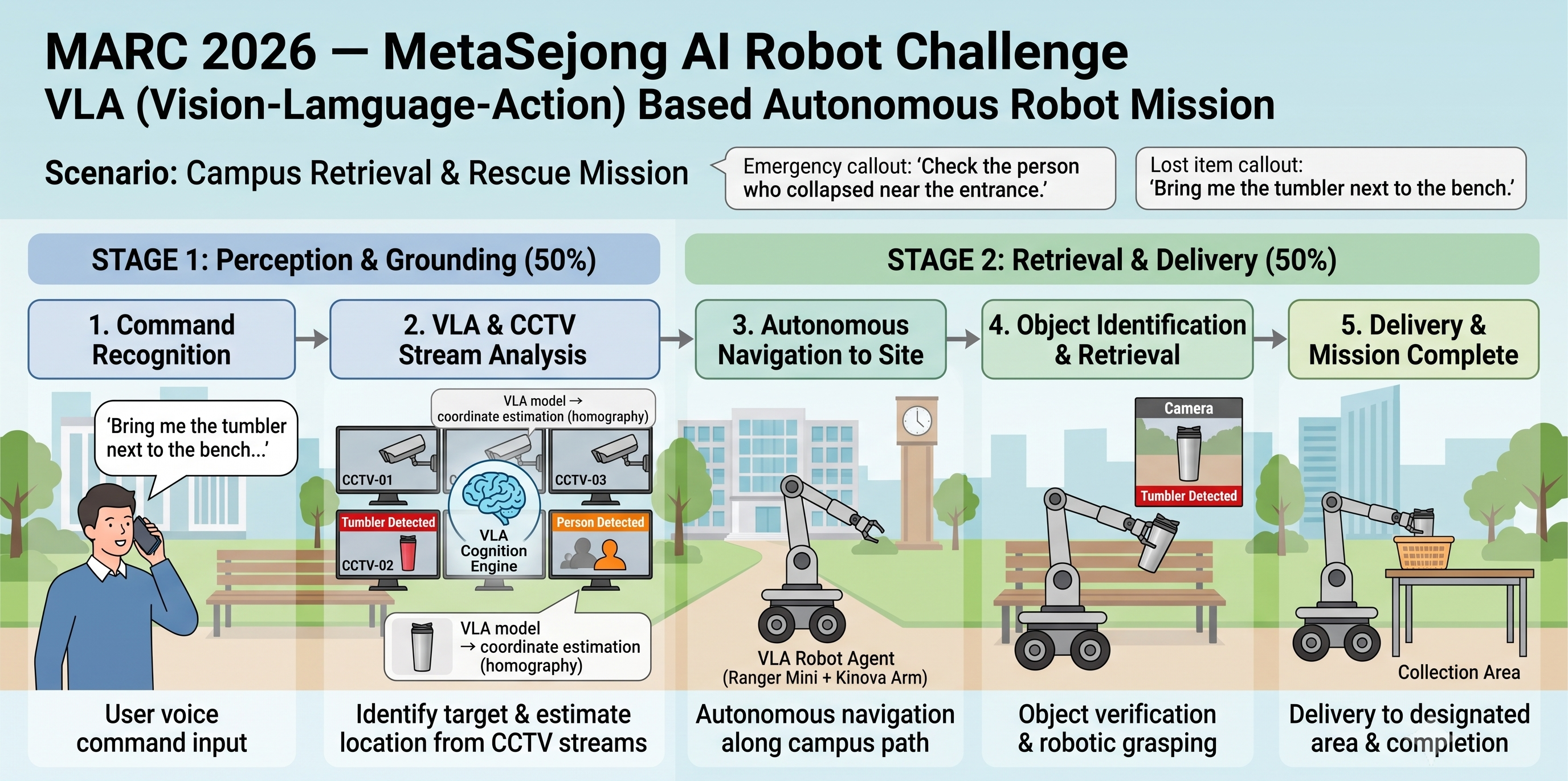
The challenge runs on a digital twin — a virtual copy of the Sejong University campus. Teams build an AI agent that takes a person’s natural-language command and the campus CCTV video as input, locates the target, and drives a robot to retrieve it.
MARC aims to become an annually held event. Where the 1st edition (2025) was a campus waste-sorting (recycling) mission, the 2026 edition extends the task to Vision-Language-Action (VLA) grounding — understanding a person’s words and carrying them through to action.
What you compete on
What you build is an AI agent that — in a virtual campus environment — understands what people say, analyzes the CCTV video, and controls the robot. The robot, the CCTV, and the campus are all provided in simulation; you build the “brain” that operates inside it.
A user’s command comes in one of two forms: asking the agent to find where the item is and report it, or asking for the item to be brought to them.
Finding the item is done through the fixed CCTV cameras placed around campus. The agent analyzes this video to work out where the item is, and in the same footage it also spots people in distress or unusual situations (SAR). If the user asks for the item to be brought to them, the agent then controls the robot to drive to that location, pick the item up, and move it to a designated place.
In short, the agent needs to:
- Understand what a person says — interpret the user’s natural-language command to work out what action the agent should take.
- Perceive from CCTV — analyze the fixed CCTV video to locate the item, and also spot people in distress or unusual situations (SAR).
- Retrieve by controlling the robot — when the command is “bring it,” the agent drives the robot to the location, picks the item up, and moves it to a designated place.
Why take part
- Strong teams join a paper track with the opportunity to publish via IEEE Xplore.
- Advance to an international finals in Xi’an, China (in conjunction with IEEE MetaCom 2026).
Key dates
| When | What |
|---|---|
| Jul 6, 2026 | Website goes live; registration opens |
| Jul 8, 2026 | Platform, guide & starter kit release |
| Aug 31, 2026 | Code & paper submission deadline |
| ~Sep 18, 2026 | Finalists announced |
| Nov 9, 2026 | Finals — Xi’an, China (IEEE MetaCom 2026) |
See the full schedule and registration on the Register page.
Organizers
Organizing committee
| Role | Name | Affiliation |
|---|---|---|
| Program Chair | Prof. Jaeho Kim | Sejong University, South Korea |
| Co-Chair | Prof. JaeSeung Song | Sejong University, South Korea |
| Co-Chair | Prof. Li Bai | Temple University, USA |
| Technical Chair | Prof. Taehyun Kim | Sejong University, South Korea |
Hosted by
IEEE MetaCom 2026 — the host conference of MARC.
Organized by




Contact
For inquiries, please use the contact channel below.
- Email: marc2026@iotcoss.ac.kr
- Submission collaborator account (for scoring):
marc-challenge-office(added as a collaborator to your private repo — see Register).